

Last month was all about how punk endeavors to affect environment. In particular, the ways in which women have been central to punk’s political message in the past decade.
But sometimes music offers us an environment in and of itself. Textures and atmospheres that we can live inside for a short time. Today, that’s our topic.
‘The Way It Breaks’ by Loathe ft. Mansur Brown
Courtesy of an unnamed reddit user from r/musicsuggestions.
Texture is what comes to mind when I hear “The Way it Breaks” by Loathe, featuring Mansur Brown. Layers of effects-drenched sound washing over me in waves is my Roman Empire. And so when I find it, I sink into it.
This song reminds me of a Logic Pro plugin I used to use on all the music I made. It was meant to replicate an old vinyl being played on a record player, with dusty static, pops, and crackles. Considering the digital nature of the recording, I wouldn’t be surprised if something similar was used. It’s a wonderful textural topping that sits upon layers of sound. And while I hope I don’t share too much in common with Billy Corgan, I do find myself aligned with him on at least one issue other than an embrace of the bald community: A love for layered sound.

Often when I think of texture, the first thought that comes to mind is that it's the most important factor in music, in what separates a good song from a great song, or a bad song from a good song.
Texture is essential in all sorts of art. For example, Vincent van Gogh’s work. I love the way his thick globs of paint left waves and ridges cresting across the surface of the canvas. And music offers us something similar in the way artists use sound.
When I think of texture, I typically think of the layered sounds of bands like The Smashing Pumpkins or My Bloody Valentine. But sometimes I'll challenge that perception with a song that finds maximal use of minimal instrumentation, such as “Waiting for My Ruca” by Sublime. At first glance, it seems like the opposite of texture. It's just a bass drum, a single note, and Bradley Nowell. And despite there being almost nothing there, it's actually my favorite Sublime song precisely for what it lacks.
After all, I love the use of negative space in visual art. Take “Rock and Grass” by Ansel Adams, for example. So much of the image is comprised of a calm pool of water, against which shocks of grass and stone announce themselves. The rock is the kick drum pounding through the emptiness, and the grass blades are Nowell’s vocals yelping above the surface. But the negative space is what makes the image.
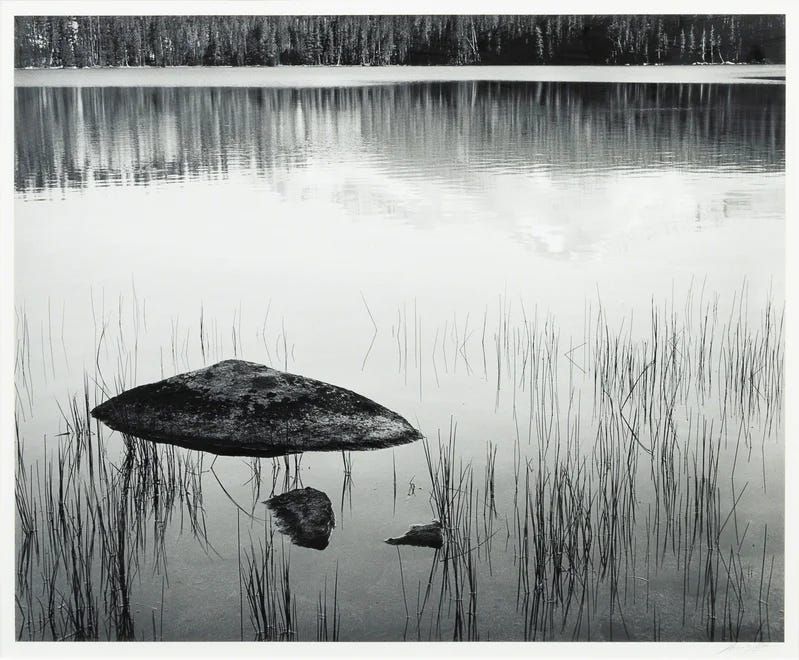
Which is my I think minimalism deserves equal consideration with deep layering, as far as texture goes. But it’s when you meld minimalism and texture that you get my beloved punk music.
The crunchy sound of the guitar distortion and the way it’s recorded in “Minor Threat” by Minor Threat is just a masterpiece. Beautiful in its perfection. It’s a pool of gasoline into which Ian McAkye can throw his match—and he does.
Another punk band, Refused, later demonstrated the value of contrasting a thick glop of distortion with a lean, muscular spring of crunch in it’s song “Pump the Breaks.” At 00:20 seconds the wall of static sludge crumbles, revealing a drumroll into a sprint of mid-tone riffing. I picture a cannon ball shot out of an embrasure carved into still-hot molten lava.
But in rock music, texture was perfected by shoegaze, a descendent of punk. And cliche as it may be to say, I don’t think anyone did it better than My Bloody Valentine. From the beginning, their wash of fine-grit textures piled into thick atmospheres was the locus of a developing scene. But their third album, 1991’s “Loveless”, is art at the level of someone like Gustav Klint. Or, come to think of it, maybe they’re more Monet with their impressionistic use of sound.
It is perfect from beginning to end. Like an introverted teenager sitting in his bedroom on a 2005 summer Saturday assembling the perfect playlist from a pirated file named “untitled 1 - unknown artist.mp4,” Kevin Shields built this album second by second, layer by layer, song by song.
Coming from the way guitarists would stare at their pedal boards while performing, the genre’s name first appeared in a review of a Slowdive EP. Their debut came the same year as the seminal “Loveless,” but the album they’re best known for is 1993’s “Souvlaki.” Along with bands like Cocteau Twins, these artists in the growing shoegaze and dream pop scenes continued to refine the layered and effects-laden sound My Bloody Valentine pioneered. And they did so with female vocalists, which I always considered a better fit for the shoegaze atmosphere.
But it was later brands like the Silversun Pickups that introduced me to shoegaze and helped me understand my own appreciation for texture and atmosphere. The Silversun Pickups’ “Carnavas” was basically “Loveless” for a new generation and I loved it. “Melatonin” remains my favorite track on the album and is the perfect name for a slow and hazy shoegaze song. Ten years later hardcore legends Title Fight also dipped their toes into the genre with their underrated, dream pop-inspired final album, “Hyperview.”
A more recent shoegaze adherent (as well as a fellow Incubus superfan) is Tanukichan. In “Hunnded Bandz,” her voice is a satin sheet floating over the a slow-swinging sledgehammer of distortion. That contrast is a perfect example of why I think women’s voices are just a better fit for the genre. They introduce a contrast, like the boom of the bass and the emptiness around it in “Waiting for my Ruca” or the gritty crag of the rock against the expanse of the water in “Rock and Grass.”
In my mind, the best current example of shoegaze is They Are Gutting a Body of Water. My favorite painter is Vincent Van Gogh, and TAGABOW’s music resembles a Van Gogh painting in the way they’re slapping thick chunks of sound onto the canvas.
The band is the darling of the shoegaze scene, and for good reason. While you can hear plenty of My Bloody Valentine in their sound, that’s not all you can hear. The story has been told plenty of times already, but it bears repeating because it explains the ways in which TAGABOW is moving the genre forward. Douglas Dulgarian, the creative force behind the band, was forced to abandon guitar playing for a brief period due to an arm injury. It was then that he began producing jungle music. That period of his life would bleed into the band’s sound. The group’s signature interludes, which they incorporate into their live shows, are all produced by Dulgarian.
The band has been active this year. Earlier in 2026 members of TAGABOW and Hooky released an album as god of war. They developed a sound I find reminiscent of fellow Philadelphia music lodestar Alex G. And this month TAGABOW dropped “KOOL FAITH / LOOSIES II.” After delving into a more rock-focused sound with their previous album, “Casino,” this latest record sees the band leaning back into its signature genre mish mash.
As much as I love TAGABOW, though, my favorite song from the resurgent shoegaze wave might be “Archie, Marry Me” by Alvvays. I can’t resist a poppy hook that as sticky sweet as a NERDS rope.
Shoegaze and dream pop are built on effect-laden guitars. But there are also electronic sonic textures and atmospheres. The occasional artful use of texture in dubstep is one of the reasons I fell in love with the genre in in the late aughts and early 2010s (along with like every other copy + paste white guy, I know). See what I had to say about Bassnectar’s “Magical World” in my post on music discovery for more on that.
But electronic textures can also have a much cooler, smooth, and stripped-down expression than you’d typically find in dubstep. Like the sound of a 5 gum commercial.
One of my favorite examples is “Idioteque” by Radiohead. The synth line in the song is the light blue line bisecting the canvas in Mark Rothko’s “No. 61 (Rust and Blue).” It sounds like an emphysema' victim’s stretched out and digitized attempts at breathing. And “Cleveland is the Reason” by Kid Cudi chops up and wahs a similar sound to perfect effect and feel.
Which brings me to my favorite instrument in jazz: The xylophone. Why? Because, used in the right way, it sounds like dipping into a rippling pool of cool metallic goo. Like if you could melt down the T-1000 from “Terminator 2: Judgement Day” into a soothing sound.
When it comes to xylophone, Milt Jackson is the master. And “Sunflower” is an example of his mastery. But there are others worth checking out, like Wolfgang Lackerschmid, who was introduced to me by a record store employee who noticed me buying a Milt Jackson vinyl. I’ve also really enjoyed the more recent textural travels of Masayoshi Fujita, who’s approach is stripped down and at times blends electronic elements.
Something common to many of the songs in the more deeply layered, wall-of-sound examples are the ways tones echo, reverb, and stretch through the space. You can hear this in the ring of a xylophone note or the reverb-laden wash of an echoing guitar strum. Examples of artists making the most out of single sounds like Jackson Pollock could wring so much from a glob of paint dripping off his brush. This sort of droning approach to music predates shoegaze by thousands of years, though.
In fact, according to Vedic texts the universe was born from a sound. Om is the sonic embodiment of Brahman, the unknowable supreme force that is everything in the universe. The all-encompassing reality. And that sound is represented in Indian classical music through vocal repetitions and droning notes. In both Hindustani and Carnatic music, the two primary Indian classical traditions, you’ll find droning notes layered with additional instrumentation and vocals. The idea is that all other notes are born from the drone, in the same away that the universe was born from Om.
When I hear that drone, I hear that texture. Which brings me to my music hot take: Shoegaze is very similar to Carnatic music. Each genre makes use of droning, layered notes to make the listener feel awash in sound. To envelope her or him in the sonic embodiment of the universe.
My first encounter with Indian classical music came through my early explorations of jazz music. My love for jazz began with “Birth of Cool” by Miles Davis. And as I dug deeper into Davis’s discography, I discovered the guitarist John McLaughlin. It was this next phase of the rabbit hole I was digging that brought me to Shakti. Put simply, with simply being about as much as I can profess to understand, Shakti is the divine feminine energy.
The concept originates with ancient goddess worship traditions in the Indian subcontinent and, like many ancient worship traditions, was folded into Hinduism over time. Within Hinduism, Shakti is personified by various deities’ wives. But, in some denominations, like Shaktism, the divine feminine energy itself is the central deity. And, similar to the universe emerging from a single sound, you can make an etymological case for matter emerging from the divine feminine.
In fact, the words mother and matter share the same Proto-Indo-European root word, méh tēr, which means mother. Just as a mother gives birth to new life, the divine feminine gave birth to all creation. And so the divine feminine is creativity, which brings us to the other meaning of the word Shakti: creative intelligence, beauty, or power. That is why when John Mclaughlin formed a jazz-Carnatic fusion band with L. Shankar, Ramnad V. Raghavan, and Zakir Hussain, they eventually settled on the name Shakti for their group.
I don’t know about you, dear reader, but I cannot help but hear the divine when I hear the music of Shakti. In fact, when I met my wife, my own Shakti, one thing we connected over early on was Carnatic music. She was raised in Mumbai in a religious family that practices a wide range of artistic pursuits, precisely because of the divinity inherent in creativity. She grew up playing the veena. To that point, Shakti was the extent of my experience with Indian classical music. As much as I loved the sound, I hadn’t done much further exploration. However, after learning about the veena I started digging deeper and I discovered Jayanthi Kumaresh.
While the veena plays the lead here, beneath it you can here the persistent percussion racing. Each slap of hand on drum sounds distinctly human. You can here skin snap off the surface of the drum, called a mridangam. Zakir Hussain’s tabla is played to similar effect in Shakti’s music. The skittering percussion forms a near-droning layer of sound itself. But in addition to that lies the true drone, the tanpura. This is one of my favorite sounds in Indian classical music. It is akin to the wash of distortion you may hear in a My Bloody Valentine track.
This article started as an explanation of why I love texture and atmosphere in music. But the texture and atmosphere you find in music are small scale representations of the universe itself that, at least in most schools of Hinduism, was created from a sound. A single, spiritual vibration that lives in all of creation and all of us. Even in the silence.
It is when we give ourselves permission to tinker, to become mother to our own creations, that we dip into the divine ourselves. With each word written, brush stroke swept across a canvas, or note plucked into existence, we are tapping into the divine creative force that exists in everything.
Sometimes that divine energy is a droning tanpura note or a wash of distortion. And other times it is the asked-and-answered question is, “can I scream?”
Chills, every time. To me, that is divine.
What’s your favorite discovery? Tell us below for a chance at a future feature:
See you next week with a song suggested by another human.
Thanks for reading! Subscribe for free to receive new posts and support my work.